

What is Session Insights?
Session Insights is an analysis feature that helps you understand what happened in your Devin sessions and provides actionable recommendations for improvement. When you trigger an analysis, Session Insights examines the session to identify patterns, issues, and opportunities for better collaboration. Session Insights is available for all completed Devin sessions at no additional cost. When a session ends, Devin automatically generates a lightweight classification (category, languages, and tools). For large sessions (L or XL), a full analysis is also generated automatically at teardown. For smaller sessions, you can trigger a full analysis manually through the UI or via the API.How to Access Session Insights
Step 1: Complete a Session
Run a Devin session and let it complete. Session Insights works best with sessions that have clear outcomes, whether successful or not. Sessions that are too short (fewer than one Devin message) will not generate insights.Step 2: Open the Insights Modal
After your session completes, open the session menu (the ⋯ button at the right end of the session’s top bar) and select Session insights.In enterprise organizations, the session’s top bar also shows a session size chip next to the session title. Clicking it opens the same Session Insights modal.
Step 3: Generate or View Analysis
In the Session Insights modal, if an analysis has not yet been generated, click Generate Analysis to start one. Generation typically takes about a minute. If an analysis already exists, you can click Regenerate to create a fresh analysis.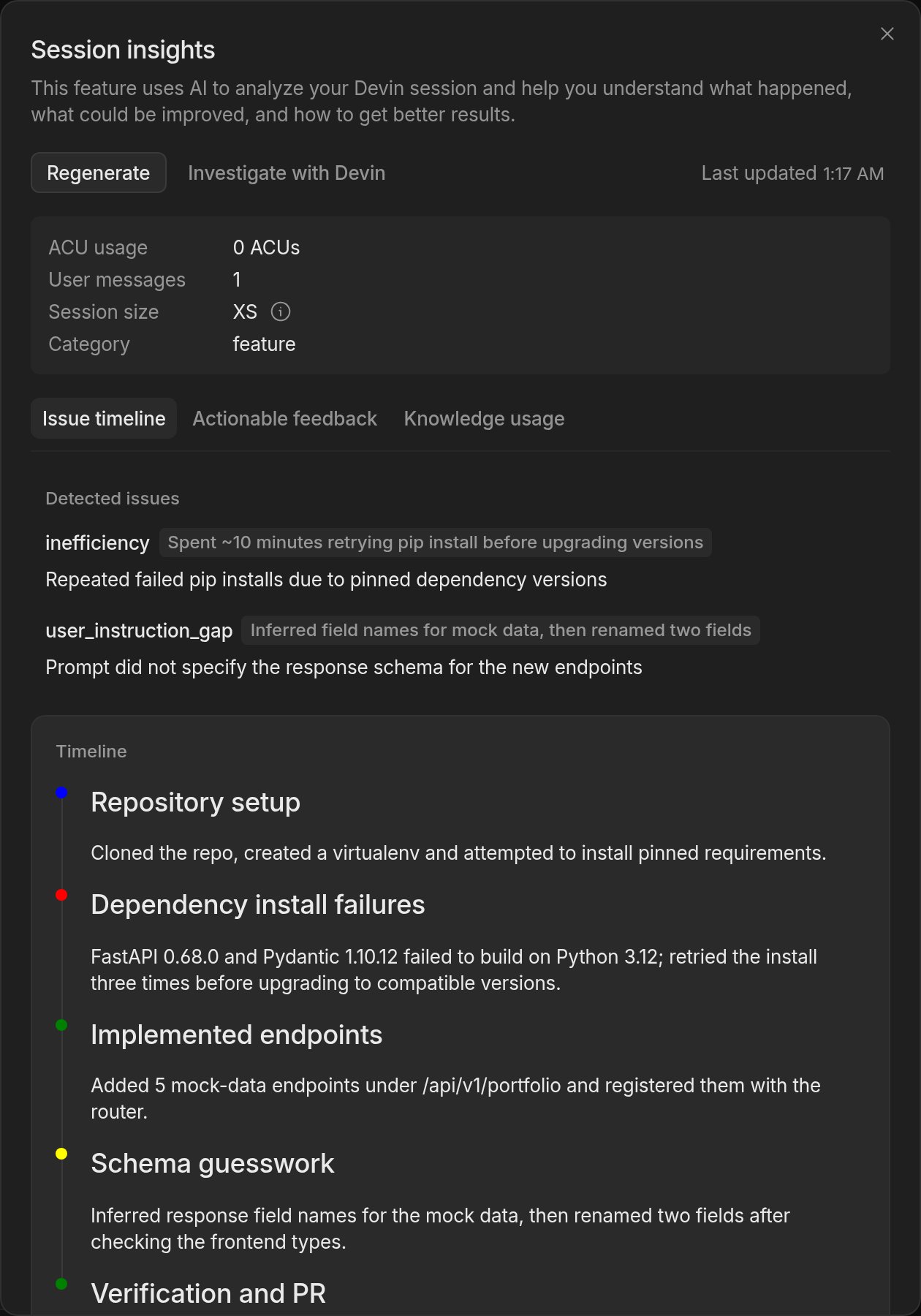
Session Overview Metrics
At the top of the Session Insights modal, four key metrics give you a quick snapshot of the session: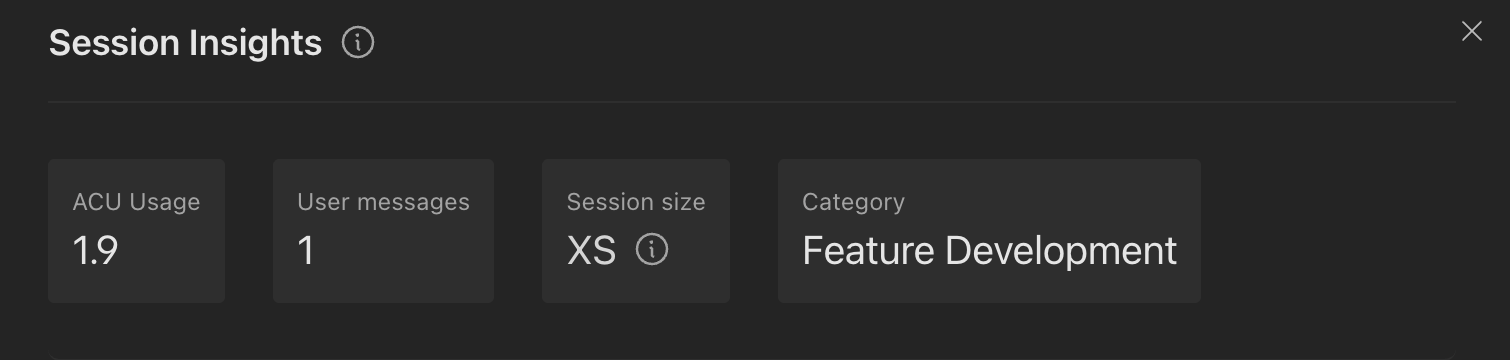
ACU Usage
ACU (Agent Compute Unit) usage reflects how much compute Devin consumed during the session. Lower ACU usage for a given task generally indicates a more efficient session. Use this metric to compare similar tasks and identify sessions where Devin may have spent excessive compute on retries or dead ends.User Messages
The total number of messages you sent during the session. A high message count can indicate that Devin needed frequent course corrections, suggesting that the initial prompt could be more detailed. Ideally, provide all important context upfront to minimize back-and-forth.Session Size
Session size is a classification (XS, S, M, L, XL) based on how much usage a session consumes, measured in ACUs. The number of user messages does not affect session size. The thresholds for each size category are:For enterprise customers, ACU thresholds are scaled by a factor of 10 (e.g., XS ≤ 20 ACUs, S ≤ 50, M ≤ 100, L ≤ 200, XL > 200). On quota-based plans, sessions are sized on their overage cost, converted to ACUs at $2 per ACU.
Category
Devin automatically classifies sessions into task categories based on the work performed. Classification also includes metadata such as the tools and frameworks used and the programming languages involved. The available task categories are:- Feature Development — building new features, components, services, or implementing new functionality
- Bug Fixing — investigating and resolving bugs, errors, or unexpected behavior
- Code Review — reviewing, explaining, or analyzing existing code and architecture
- Refactoring & Optimization — improving code structure, performance, or readability without changing behavior
- Test Generation — writing, fixing, or improving tests (unit, integration, e2e, QA) and test infrastructure
- Migrations & Upgrades — upgrading dependencies, migrating between frameworks or versions
- CI/CD & DevOps — CI/CD pipeline work, deployment, monitoring, alerting, and infrastructure tasks
- Security — fixing security vulnerabilities, addressing CVEs, and improving security posture
- Data & Automation — data analysis, pipelines, scripting, dashboards, and automation tasks
- Documentation & Content — writing or updating documentation, READMEs, changelogs, API docs, and translations
- Research & Exploration — exploring feasibility, researching solutions, designing architecture, writing RFCs, and prototyping
Analysis Tabs
The Session Insights modal contains three tabs, each focused on a different aspect of the analysis.Issue Timeline
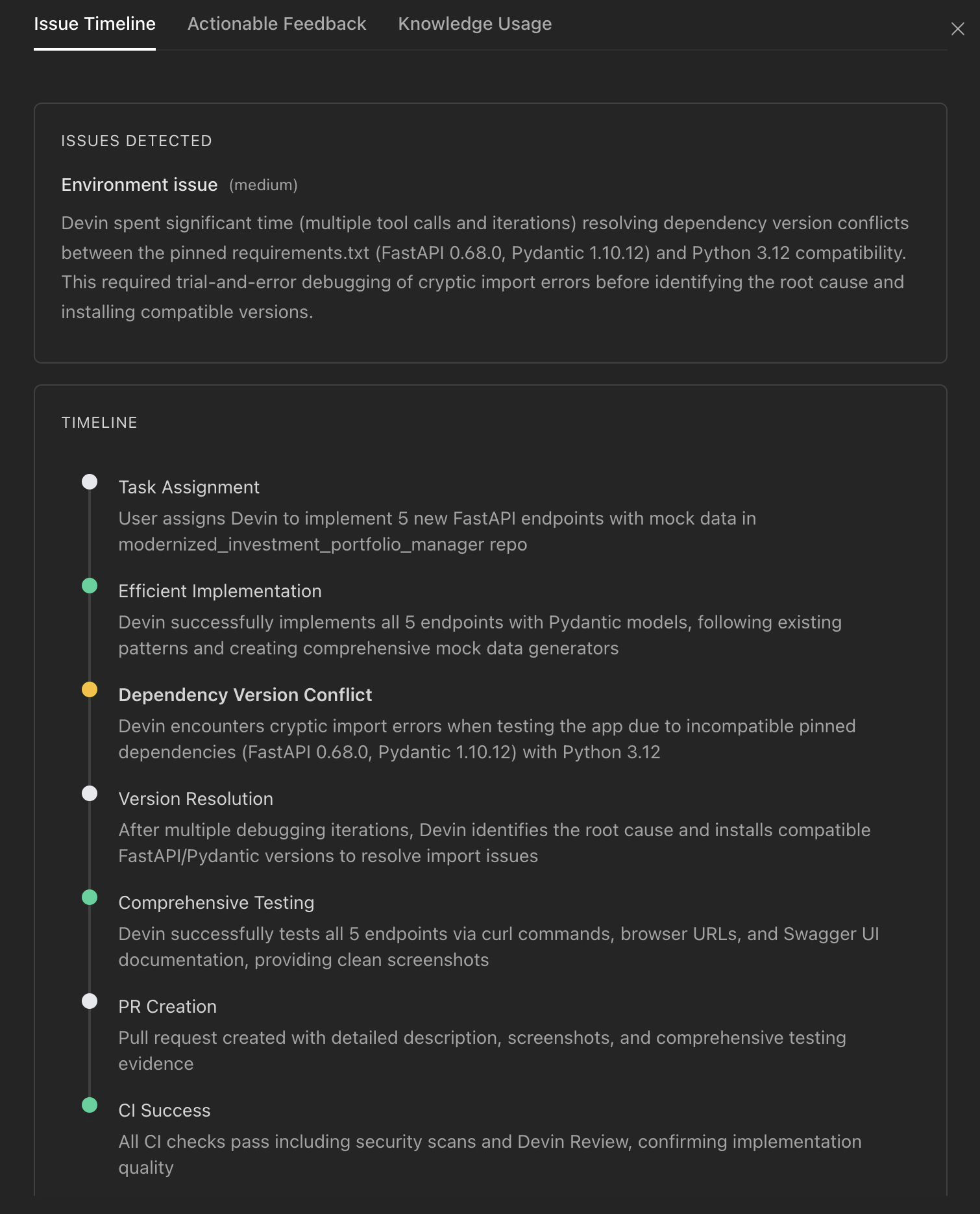
- A label describing the issue category
- An impact rating (high, medium, or low)
- A description explaining what went wrong
Each timeline event has a title and description. Events linked to specific issues appear in bold. Use the timeline to understand the flow of the session — where Devin made progress, where it hit obstacles, and how it recovered.
Actionable Feedback
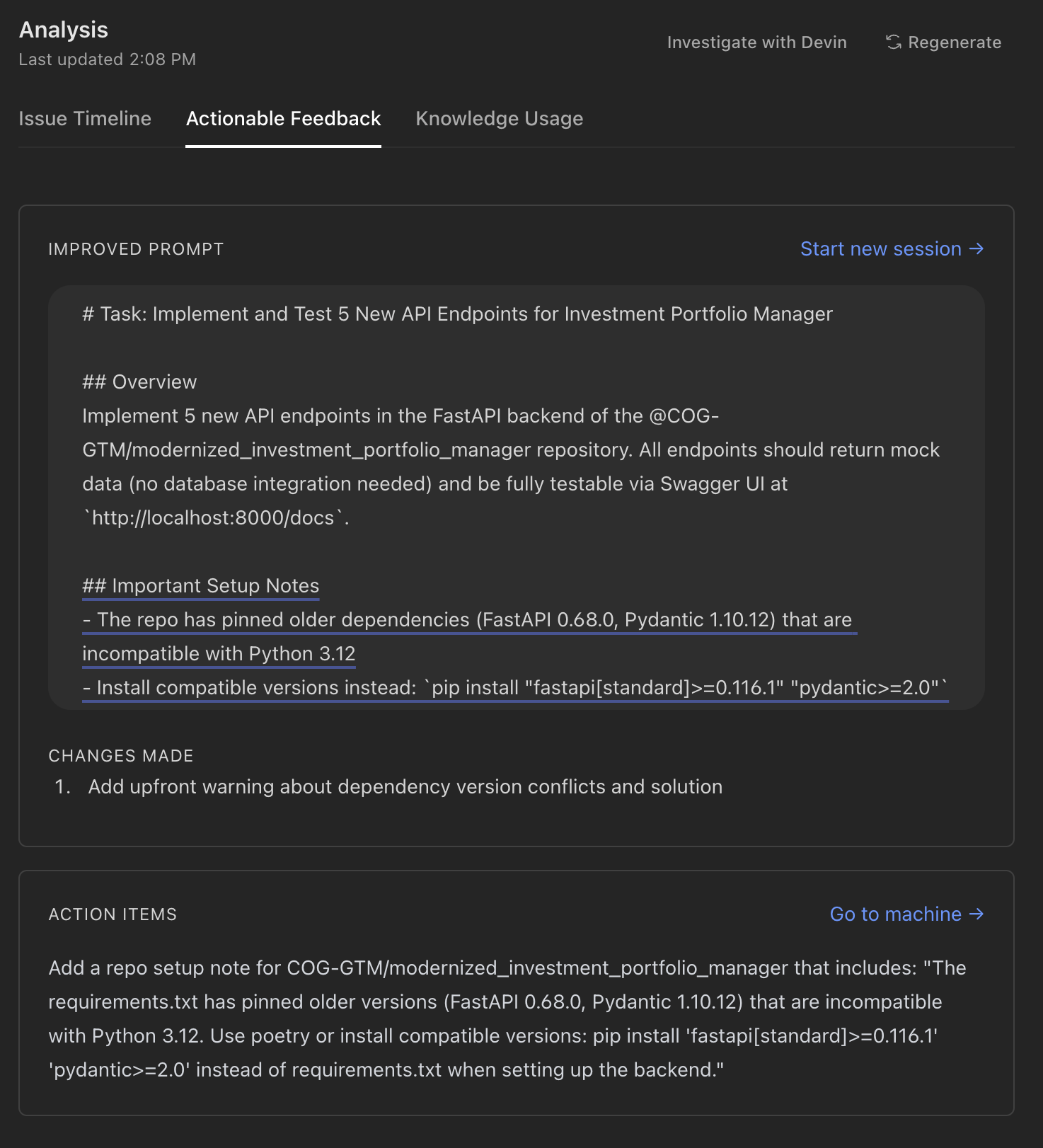
- Added context or constraints that were missing from the original
- Clarified ambiguous instructions
- Included success criteria or specific requirements
- Frontloaded important information that Devin needed earlier
- Machine setup — environment or tooling changes (e.g., installing missing dependencies, configuring access)
- Repo config — repository-level changes (e.g., adding build scripts, updating configuration files)
Knowledge Usage
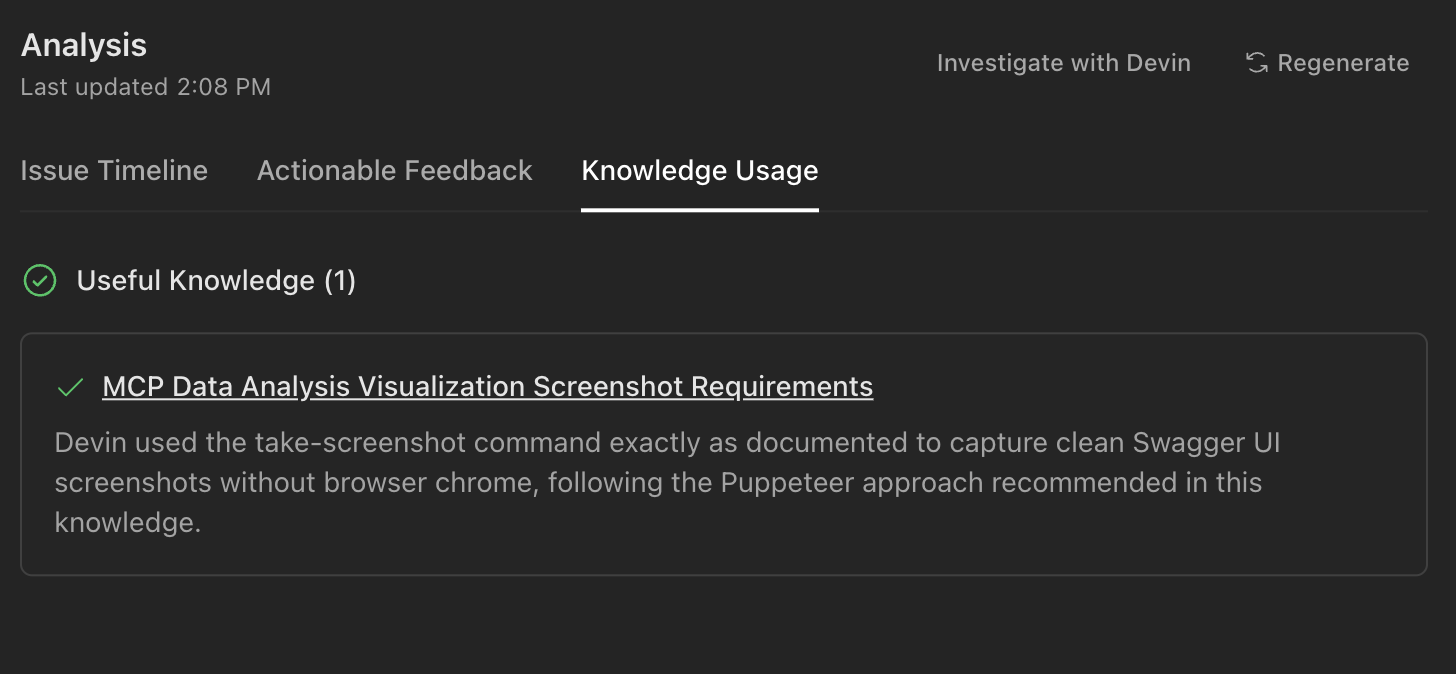
Interpreting Common Insight Patterns
High ACU Usage with Few User Messages
This typically means Devin worked autonomously but struggled with the task. Check the Issue Timeline for recurring errors or retries. Common causes:- Missing environment setup (dependencies, API keys, access credentials)
- Ambiguous requirements that led to trial-and-error approaches
- Complex tasks that would benefit from being broken into subtasks
Many User Messages with Low ACU Usage
This suggests frequent interruptions or course corrections. Devin spent little compute but needed constant guidance. Common causes:- Underspecified initial prompt
- Devin misunderstood the task scope or requirements
- The task required domain-specific knowledge not available to Devin
Misleading Knowledge Flagged
When the Knowledge Usage tab shows misleading knowledge items, those items may contain outdated instructions or overly broad advice that conflicts with your current codebase. Common causes:- Knowledge was written for a previous version of your codebase
- Knowledge is too general and gets retrieved in irrelevant contexts
- Knowledge conflicts with other knowledge items
Session Classified as Wrong Category
If the category shown in the overview does not match what you intended, it likely means Devin interpreted your request differently. Common causes:- The prompt was ambiguous about the goal
- The task description focused on one aspect but the intent was different (e.g., describing a bug when you wanted a feature)
Timeline Shows Repeated Issues
When the same issue type appears multiple times in the timeline, Devin likely got stuck in a retry loop. Common causes:- A persistent build or test failure that Devin could not resolve
- An environment issue (missing tool, wrong version, permission error)
- A fundamental misunderstanding of the approach needed
Best Practices
Review Insights After Complex Sessions
Make it a habit to check Session Insights after important or complex sessions. The patterns you identify will help you become more effective over time.Apply Prompt Improvements Iteratively
Use the suggested improved prompts as starting points for similar future tasks. Over time, you will develop a library of effective prompt patterns. Save your best prompts as Playbooks for repeatable workflows.Maintain Your Knowledge Base
Regularly review the Knowledge Usage tab to keep your knowledge items accurate and relevant. Remove or update misleading knowledge promptly — a single outdated knowledge item can degrade session quality across your entire team.Address Recurring Issues via Machine Setup
If Action Items consistently recommend the same environment or configuration changes, address them proactively. Setting up your environment configuration correctly prevents repeated issues across all future sessions.Share Insights with Your Team
Session Insights can reveal patterns that benefit your entire organization. Add key learnings as Skills so your teammates can benefit from them.Keep Sessions Focused
If your sessions consistently classify as L or XL, break large tasks into smaller, more focused sessions. Smaller sessions tend to produce better results and are easier to analyze and iterate on.Troubleshooting
No Insights Available
If Session Insights is not available for a session, it may be because:- Analysis has not been triggered yet — click Generate Analysis in the Session Insights modal or use the generate API endpoint
- The session is still in progress
- The session was too short to generate meaningful analysis (fewer than one Devin message)
- There was an error during the analysis process — try clicking Regenerate